



Approach
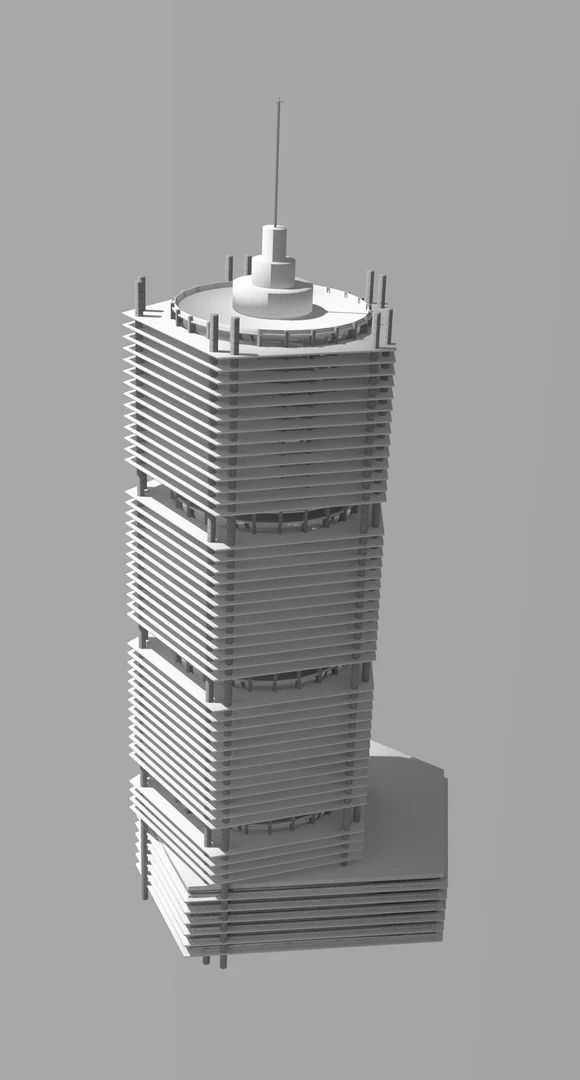
Our engineering approach is built around system-level understanding of high-rise structures, where global stiffness distribution, load path continuity, and dynamic response govern overall performance. Rather than treating design as a sequence of isolated checks, each project is developed as a fully coupled structural system subjected to gravity, wind, seismic, and time-dependent effects. This requires consistent integration between conceptual modeling, numerical analysis, and design interpretation to ensure that structural behavior is understood at both global and local levels throughout the development process.
Wind, seismic, and gravity loads are not treated as independent cases but as interacting demands influencing the same structural system. Load combinations are developed to reflect governing limit states, while dynamic effects are evaluated through modal and time-history analysis methods. Emphasis is placed on understanding how lateral forces redistribute through cores, outriggers, and perimeter systems, and how this redistribution affects drift, acceleration, and internal force demand. The objective is to ensure that analytical output directly informs structural decision-making rather than functioning as a verification step alone.
High-rise engineering is approached from the perspective of structural systems rather than individual members. Core elements, perimeter framing, outriggers, and foundation systems are evaluated as interacting components within a continuous load-resisting framework. Particular attention is given to stiffness hierarchy, torsional stability, and redundancy under lateral loading. Early-stage decisions regarding core location, column spacing, and system typology are treated as primary drivers of final structural efficiency, often having greater influence than detailed member design at later stages.
Structural modeling is developed using three-dimensional finite element representations that capture both global behavior and localized effects. Models incorporate material nonlinearity, geometric nonlinearity (P-delta effects), and staged construction sequencing where relevant. Element stiffness assumptions are carefully calibrated to reflect realistic cracked section behavior in concrete and connection rigidity in steel systems. The modeling process is iterative, with continuous refinement between analysis output and structural configuration to ensure convergence toward stable and efficient system behavior.
Choose Us
High-rise engineering is a problem of managing tightly coupled structural interactions where small
changes in system definition can significantly alter global response. Our focus is on resolving those
interactions early, when the structure is still being defined at a system level rather than locked into
detailed assumptions. This allows stiffness, mass distribution, and load paths to be shaped
deliberately rather than adjusted reactively later in design.
A key challenge in tall buildings is maintaining structural continuity through architectural
complexity. Offset cores, transfer structures, large cantilevers, and irregular floor plates introduce
discontinuities in load transfer that must be resolved at the system scale. Instead of simplifying these
conditions, we work through them directly by maintaining a clear understanding of how forces
travel through the entire height of the structure.
Early-stage uncertainty is treated as part of the design process rather than a limitation. Multiple
structural configurations can be evaluated consistently by maintaining a stable analytical framework
that allows fair comparison between alternative systems. This is particularly important when
assessing different lateral systems or hybrid structural solutions where stiffness and mass
distribution vary significantly.
Our work is driven by performance metrics that define how the structure will actually behave:
- Interstory drift under wind and seismic loading
- Torsional sensitivity in asymmetric or irregular towers
- Acceleration response governing occupant comfort
- Long-term deformation from creep, shrinkage, and differential shortening
These parameters are not treated as verification outputs but as active design drivers that influence system selection and refinement.
We also place strong emphasis on long-horizon structural effects that are often underestimated in
early design stages. Time-dependent axial shortening, redistribution of forces between core and
perimeter systems, and staged construction effects can all influence final geometry and internal
stress states in ways that must be captured consistently within the analytical model.
Another important part of our approach is how we evaluate structural systems before they are
finalized. Instead of optimizing a single assumed scheme, we routinely test multiple configurations
under identical loading and modeling assumptions. This allows objective comparison of system
efficiency and identifies performance trade-offs that are not visible through code-based checks
alone:
- Alternative core and perimeter configurations
- Different outrigger and belt truss locations
- Varying stiffness distributions across building height
- Material system comparisons (steel, concrete, composite)
This comparative process often reveals non-intuitive solutions that improve both performance and
material efficiency.
Beyond analysis, a significant part of our approach is ensuring that engineering decisions remain
traceable. The reasoning behind system selection, stiffness allocation, and load path definition is
documented in a way that allows others to follow the logic without ambiguity. This reduces
uncertainty during coordination and ensures alignment between engineering intent and design
development.
Ultimately, our value lies in bringing clarity to complex high-rise systems. By maintaining
consistency between structural concept, analytical modeling, and final interpretation, we reduce
unnecessary complexity and produce structural solutions that are rational, efficient, and technically
defensible across the full lifecycle of the building.