

CONSTRUCTION CONSULTANTS OF SOUTH FLORIDA, INC
Workflow
High-rise structural engineering is driven by how a system responds under combined and interacting
actions rather than by isolated design checks. Our process is structured around understanding that
response early, then refining it through a continuous cycle of modelling, evaluation, and system
adjustment. Each project is treated as a complete structural entity where geometry, stiffness
distribution, load paths, and boundary conditions are assessed together from the outset, rather than
introduced sequentially. This allows critical performance issues to be identified when the system is
still flexible enough to be shaped efficiently.
The starting point is always the definition of structural intent at a system level. This involves
translating architectural form into a viable structural framework, including core positioning, lateral
system selection, and initial load transfer strategy. At this stage, multiple structural configurations
are often developed in parallel to understand how different systems influence global stiffness,
torsional stability, and material demand. The emphasis is not on selecting a single solution quickly,
but on exposing the true structural implications of each viable alternative under consistent analytical
conditions.
Once a baseline system is established, we develop detailed three-dimensional finite element models
that represent the full building behavior. These models incorporate nonlinear effects where relevant,
including material cracking in concrete, second-order P-delta effects, and stiffness variation across
construction stages. Wind and seismic actions are applied using appropriate dynamic methods,
allowing the structure to be evaluated under realistic loading conditions rather than simplified
approximations. The model becomes a decision-making tool, continuously updated as the design
evolves.
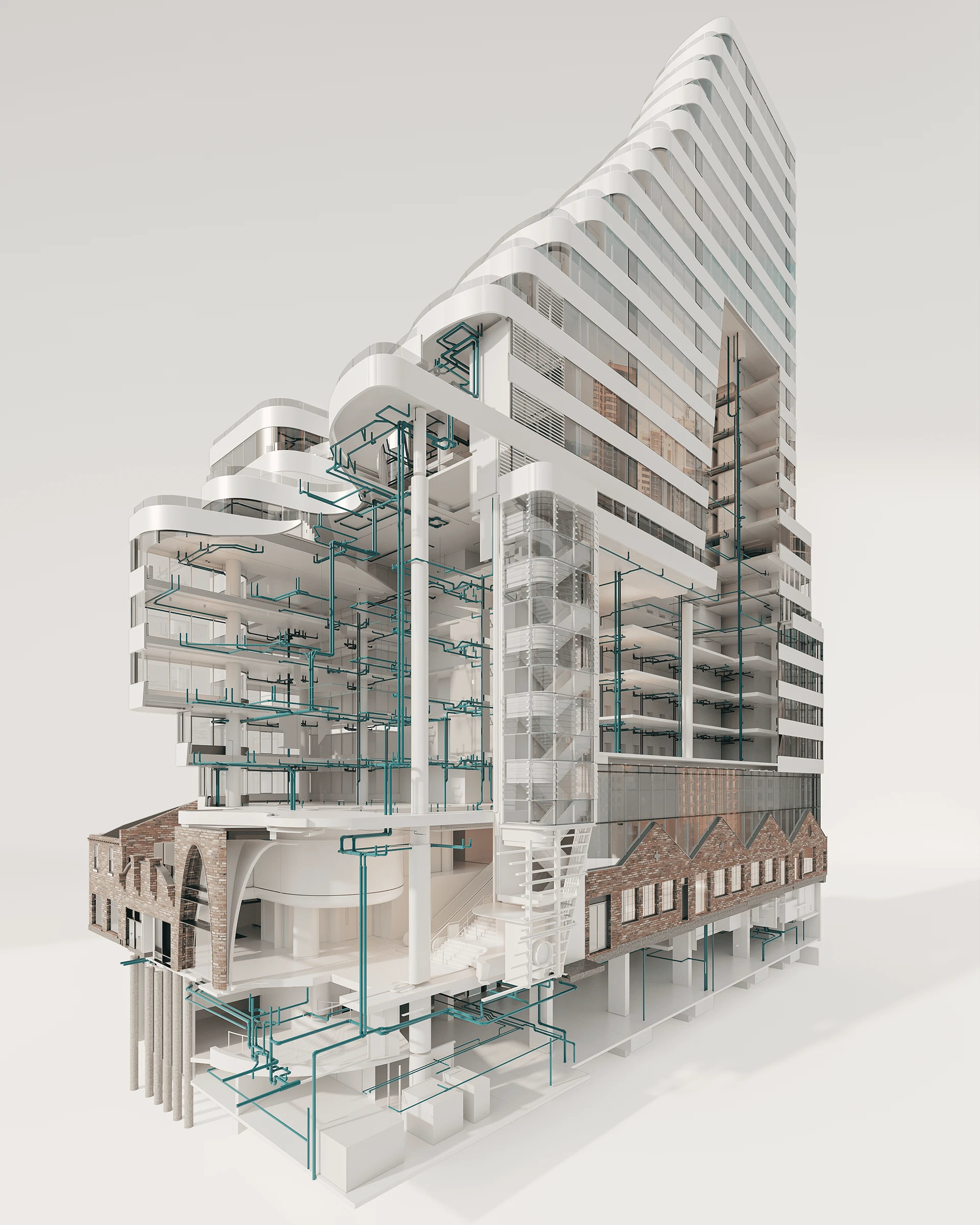
At this stage, performance is assessed using explicit structural criteria that govern high-rise design
outcomes:
• Interstory drift under wind and seismic loading
• Peak and RMS acceleration for occupant comfort
• Torsional response and eccentricity amplification
• Long-term vertical shortening from creep and shrinkage
• Differential movement between core, perimeter, and façade systems
• Foundation rotation and settlement compatibility
These criteria are not treated as final verification outputs, but as active constraints that directly
influence structural configuration. For example, excessive acceleration may require stiffness
redistribution rather than local strengthening, while drift sensitivity may lead to changes in core
geometry or lateral system selection.
Design limits are evaluated in parallel with performance metrics, ensuring that both strength and
serviceability are controlled within appropriate boundaries:
• Wind-induced acceleration limits for occupant comfort
• Code-based drift limits for serviceability and façade performance
• Seismic ductility and demand-capacity relationships
• Rotation limits at foundation level for stability and alignment
• Long-term deformation tolerances affecting architectural interfaces
Where these limits are approached or exceeded, the structural system is adjusted at a global level
rather than modified locally. This may involve revisiting the lateral system type, modifying stiffness
distribution, or rebalancing load sharing between core and perimeter elements. The objective is
always to resolve performance issues at the system scale.
As the design progresses, iteration becomes continuous rather than sequential. Analytical results
directly inform structural refinement, and each revision is tested against the same performance
framework to ensure consistency. This creates a controlled feedback loop where system efficiency
improves progressively without introducing instability or unintended secondary effects.
Throughout the process, clarity of engineering logic is maintained. Every assumption, modelling
choice, and performance outcome is documented in a way that preserves traceability from initial
concept to final structural definition. The result is a design process where structural behavior is not
only predicted, but actively shaped through consistent evaluation of system-level performance
criteria and design limits.