



Aerodynamic Load Assessment
Aerodynamic load assessment evaluates wind pressure distribution over the building envelope using wind tunnel data, computational fluid dynamics, or code-based exposure models. Variations in façade geometry, setbacks, and corner conditions are analyzed to determine localized pressure coefficients and global force distributions. Special attention is given to crosswind excitation mechanisms, which often govern dynamic response in slender towers. Resulting load cases are translated into equivalent static and dynamic representations for integration into global structural models, ensuring accurate representation of wind-induced demand across multiple directions and exposure scenarios.
Dynamic Response Evaluation
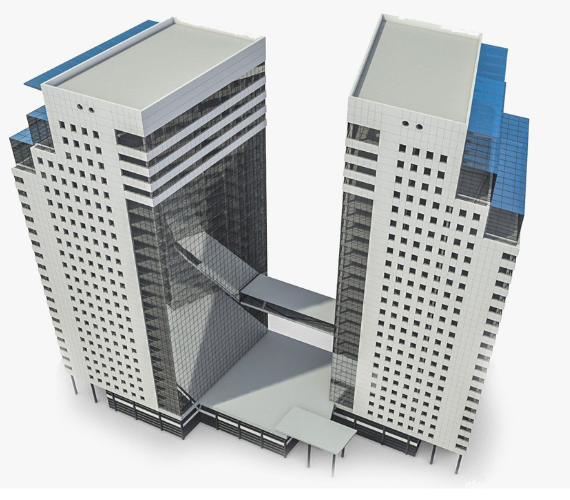
Dynamic response evaluation examines the structural reaction of high-rise buildings under fluctuating wind loads using modal and time-history analysis techniques. Natural frequencies, mode shapes, and damping ratios are identified to predict amplification effects and resonance conditions. Interstory drift and global displacement patterns are assessed to determine overall lateral flexibility. Coupled torsional and translational modes are carefully reviewed, particularly in asymmetrical or irregular building forms. This analysis ensures that dynamic effects are accurately captured and appropriately controlled within structural stiffness and mass distribution strategies.

Occupant Comfort and Acceleration Control
Occupant comfort assessment focuses on wind-induced accelerations experienced at upper levels of tall buildings, where motion perception becomes a governing serviceability criterion. Acceleration thresholds are evaluated against established comfort standards, considering both frequent and extreme wind events. Structural modifications such as stiffness enhancement, mass redistribution, or damping systems are assessed to reduce perceptible motion. The analysis also accounts for directional variability of wind events and building orientation effects, ensuring consistent comfort performance across different exposure conditions and occupancy scenarios.

Aeroelastic Effects and Instability Screening
Aeroelastic effects are evaluated to identify potential instability mechanisms such as vortex shedding lock-in, galloping, or torsional divergence in slender structures. These phenomena are assessed through scaled wind tunnel testing or advanced numerical simulation techniques. The interaction between structural flexibility and aerodynamic forces is examined to determine susceptibility to dynamic instability. Where necessary, geometric modifications or stiffness redistribution strategies are developed to mitigate adverse aeroelastic responses and maintain stable structural performance under extreme wind exposure conditions.

Wind Tunnel and Numerical Integration
Wind tunnel testing results are integrated with structural analysis models to provide calibrated load inputs and response predictions. Data from boundary layer testing is processed to generate pressure time histories, force coefficients, and spectral response functions. These outputs are mapped onto finite element models for dynamic simulation and serviceability evaluation. Where physical testing is not used, high-fidelity numerical simulations are employed to approximate wind effects with comparable resolution. This integrated approach ensures consistency between aerodynamic loading assumptions and structural response predictions.

Deliverables
Deliverables typically include wind engineering reports, dynamic response summaries, acceleration and drift evaluations, and load data packages suitable for structural integration. Documentation also includes interpretation of wind tunnel or simulation results, along with recommended design modifications where required. Outputs are structured to support direct implementation into structural design models and coordination with architectural form development. The result is a technically robust framework for managing wind-induced effects in high-rise building design.